What is your expectation when you hear “intercultural training”?
I ask this question to some of my potential customers or during course preparation. I would usually get similar answers: people see themselves in a seminar room, listening to some presentations about a foreign culture and doing some workshop-like tasks or group work. People too often expect to learn “something” from intercultural training, but are quite unspecific about the way people in a foreign culture live, their beliefs, values and customs and, usually, my clients hope to learn as much as possible about dos and don’ts in their new environment so as not to humiliate themselves or others when interacting with the people in their target culture.
Although feedback received from course participants made me confident that most of them would do well in their new cultural field, I sensed that something important would be missing – something I could not deliver in a seminar-like environment.
Let me give you one example:
When I use to talk about a Vietnamese family and explain the strong family boundaries, where the younger generation usually takes care of the older, I realized that a German seminar participant would see a different image than a person from Italy unless I got very much into detail. In Germany, “taking care” would mean to help and support the mother/ father or grandmother/grandfather so they could lead an autonomous life as long as possible. A person from a southern part of Italy would more likely see an image of the older generation living together in the same household as the younger. But what “taking care” of the elders really means for a Vietnamese person can hardly be explained in a seminar course unless I got very detailed. Therefore, a seminar offers too little time and making use of that intercultural knowledge would be limited. Our big question was: how can learning be improved and how can we help our participants to make use of their intercultural knowledge to put it into intercultural competences faster?
Let’s go out of the seminar room into the real world!
David A. Kolb, an American educational theorist, developed the Experiential Learning Model. He states that “knowledge results from the combination of grasping experience and transforming it.”
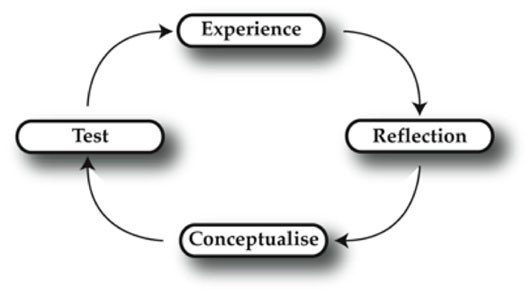
On our mission to help people from other countries become culture masters in Vietnam, we needed to let them make their own experience while, at the same time, making sure that these experiences would not be perceived as negative.
The ideas of a culture retreat and culture contrast tours were born.
On top of our classical seminar-like intercultural training courses about Vietnam, we take our guests on a half-day culture contrast tour through Ho Chi Minh City or we organize a culture retreat in the Mekong Delta, a place where we show the cultural of people living in the countryside.
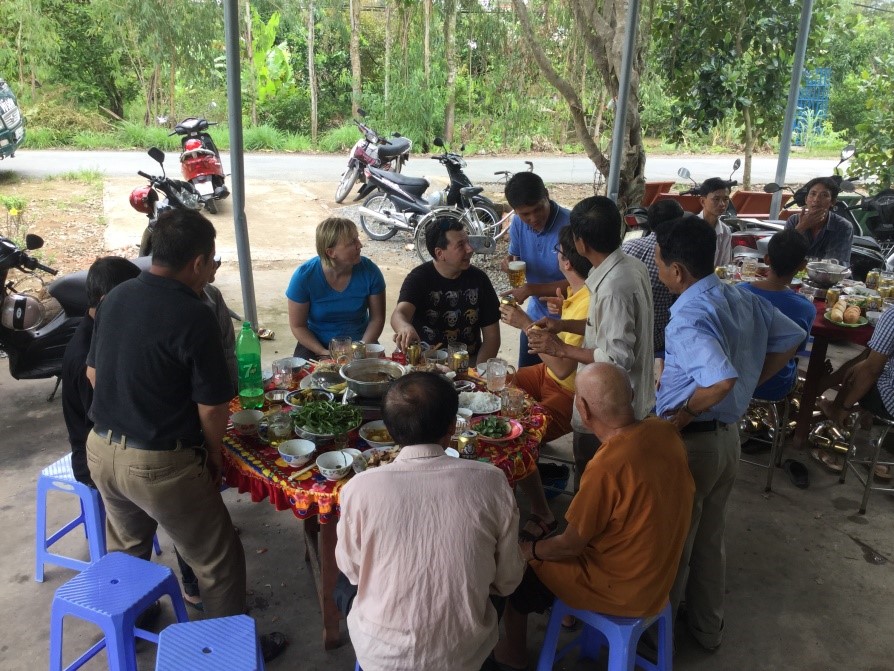
Through interaction with the locals, our guests can experience what it is like to live in a Vietnamese family, the importance of food, how creativity is perceived compared to their own country, etc. We organize activities with locals, provide them with translation and start discussions about the cultural situations they have experienced in a coaching process – with the goal to transform the newly gained experience into intercultural competence and a positive attitude in intercultural encounters with Vietnamese people in their private life or at work.
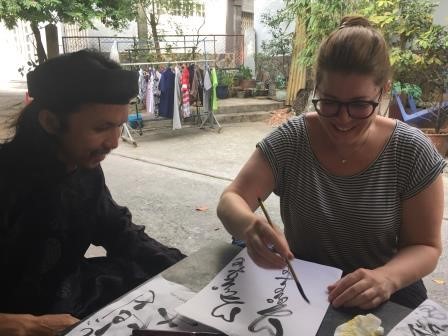
When I meet former customers today, we hardly talk about what we discussed in the seminar room. But very often, we discuss things we experienced together on a culture contrast tour or at a culture retreat. One couple told me how impressed they were and how they learned what it means to live in a society with high power distance when they saw the boss of a soup restaurant holding a pack of cash in her hands. And they told me they remembered that situation when they learned more about the role of women in the Vietnamese society and how finances are managed in many families. Another person reminded me how taking a calligraphy course from a master in calligraphy was an eye-opener when she needed to explain new things to her Vietnamese staff. In her eyes, the way of teaching and cognition differ in the Vietnamese culture from where she comes from. From that day on, she adapted her way of explaining new things to her staff – with higher success for both sides.
Gaining cultural knowledge is necessary and it is highly recommended to learn when preparing for expatriation or other kinds of intercultural encounters. However, the process of transforming that knowledge into intercultural skills, or even cultural intelligence, is a process where many expats are left alone – with the risk that bad experiences can make their expatriation a disappointing experience. Experiential learning is a way to accelerate the process from transforming cultural knowledge into intercultural skills. It can also help to develop targeted skills for specific needs in business or private life.
And by the way, it can be much more fun than just sitting in a seminar room.